"
Juvenile Justice" - The term is radical, indeed, in a country where "Justice" itself is an amorphous concept plagued by
selection bias in its delivery.
This is why the
Juvenile Justice Act is a "progressive" one - it not just underlines the need to deliver justice to those below 18 but also talks of following an empathetic, needs-based, reformist approach by all stakeholders while that is being done. This blog post is a story of a field-visit that my
NPA squad undertook officially to get sensitized about the issues confronting the enforcement of this act.
We were asked to go to a prominent bus stand of Hyderabad and spot "
Visibly Lost Children". Mr. Isidor Phillip, the social worker who helped us understand the importance of the act, defined them as children whose childhoods have been snatched away and they are left to fend for themselves in an alien environment with no meaningful choice to exercise.
So, off we went, dressed in our civil clothes, with vague notions of poor children in our minds, and a hidden desire to enjoy this day that has been freed of evening outdoor sessions. All of us have seen them - almost naked, lonely children - begging on our street lights, or selling barely-useful Chinese plastic-ware, or just taking care of their younger sibling on the side of the road.
What we haven't done is to try talking to them. When we did try to talk - we were in for a surprise.
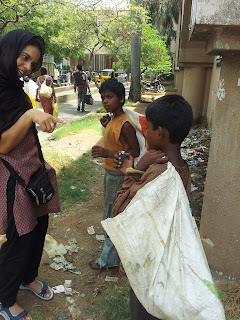 |
Visibly Lost Children who would run away
as soon as we asked personal questions |
The moment we asked questions pertaining to their personal lives - families, income, etc - the rag picking boys became suspicious and started to run away. Same was the case with the begging children. So sharp was their instinct to sense abnormal interest that some of the children who were loitering around around, would start to gradually walk away as soon as I or anyone else, would approach them.
What have we done to these children so as to make them so suspicious to the entire world around them?
After a couple of hours of spotting helpless children, our teams found one child (age around 10 years) working in a restaurant in abysmal conditions and a girl child lost on the bus stand.
I turned my attention to the child labour Hussain, who was apparently sent off by his poor family, living in northern Karnataka as a sort of repayment of his father's debt to the owner of the restaurant. The boy was really shocked and afraid, as any child of his age, surrounded by 10 strangers in a room where a policeman stands guard outside, would be.
 |
| A frightened Hussain |
However, as it turned out, while my squad mates discussed the legal implications of the two cases and the steps to be taken further (due to the complete ignorance of the law amongst the local SHO, some of us had to talk tough on him so as to make him understand that these are not simple run-away cases that can be solved with mere verbal police intervention, they needed the intervention from the CWC), I became very good friends with Hussain. It took a few chocolates, a large number of funny games on my touch-screen phone and few witty comments about the obesity of some of my squad mates to finally make him comfortable. That's when he began to talk.
 |
| A pic clicked by Hussain |
The boy didn't mince words in saying that he wanted to go home ("
ghar jaana hai"). He described how he had his extended family, friends and parents in his home town, where he attended school. There came a stage where he would not sit quietly while a serious discussion on his case was on, and would take pictures from my phone. This was when he saw some pics of mine in uniform and asked
"Tum police hai kya ji?" (Are you police?). He also asked me
"Tumhara jaat kya hai ji?" (What is your caste?). I was taken aback by this question because, no one had discussed religion or caste since we met. I said, I don't know what caste is and asked him what it is. He replied
"Main mussalman, jaat toh hota hai na ji sabka" (I am a Muslim and everyone has a caste).
 |
It was a tough 2 hour deliberation session with the
SHO, until he was told about the Govt. Order |
Now let me propound upon the quality of enforcement of the Juvenile Justice Act. For any law to be enforced, there should be a person to enforce it and he should atleast know that he is supposed to enforce it. However, when we interacted with the police officials of that prime urban police station, where NGOs like Divya Disha have spent years in spreading awareness about JJA, we found that except the SHO, very few were aware about the law and the role of police under it. This is when Andhra is considered to be one of the better states in the act's enforcement, what is the state in other states can be left to your imagination.
The SHO was in favour of dismissing them there and then. Mr. Isidore Philips had to refer to a govt. order of the same year so as to tell the SHO that Child Welfare Committee (CWC) will be the body to decide upon the two cases. This is the fate of Govt. Orders on the cutting edges of police organisations.
When we don't know the law, how can we implement it?
This is where the role of IPS officers becomes important. They can actually make the enforcement meaningful, and once the people get a taste of these much-needed laws, they will begin to demand their enforcement. Until that happens, these officers need to act as
change agents. After all, what excuse have we got in not doing the needful here?
There will be no political intervention if we take an illegally-employed child labour from a commercial setup and send him home.
We dont need extra funds or man-power to do that (especially in the cities where there are umpteen policemen posted in the name of routine protocol duties)
, all we need is a desire to deliver justice. So rather than waiting for a Supreme Court-driven initiative to reform our entire organisational setup, let us do our bit to deliver better justice while we can with the laws already there with us.


